A Warehouse with a Story
Begin in No. 1 Warehouse itself — an 1802 sugar store that is now the museum’s most important object.
16 narrated clips through a Georgian sugar warehouse — the Thames, the Port of London, sugar and slavery, and the rise of Canary Wharf. Stream or download for offline listening.
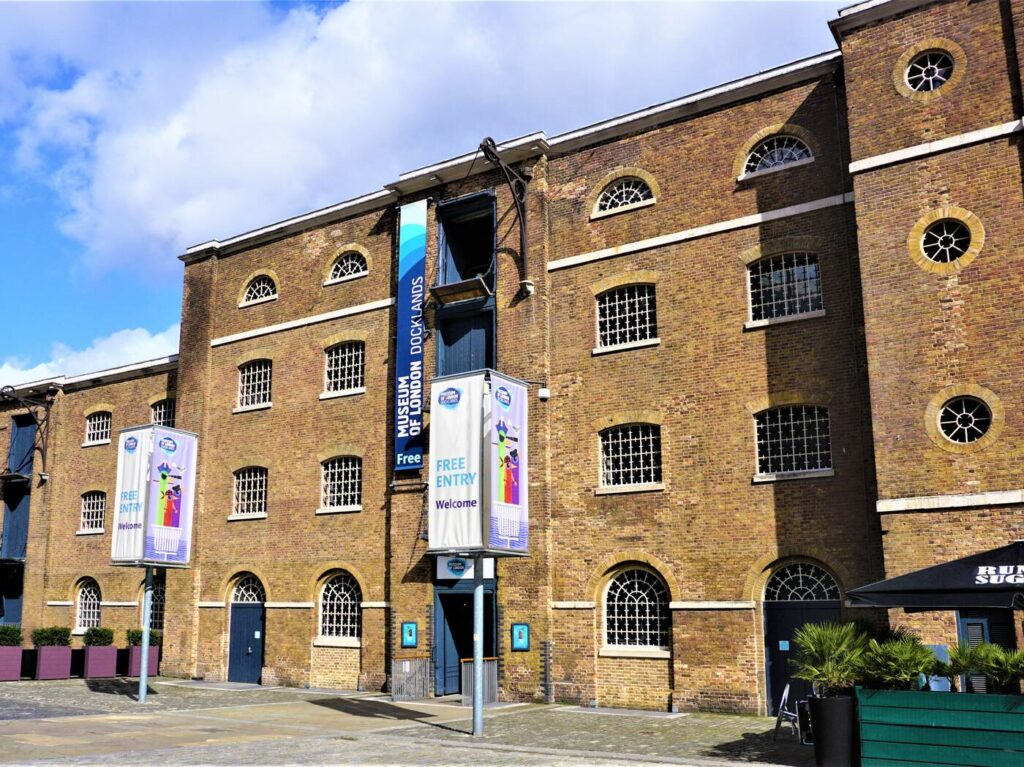
Explore London Museum Docklands with a professional audio guide to the River Thames, the Port of London, and the people who made West India Quay. Walk the Grade I listed warehouse with clear commentary shaped around the galleries you will actually visit — from Roman river to Canary Wharf.
London Museum Docklands occupies No. 1 Warehouse on West India Quay, a Grade I listed Georgian “low” sugar warehouse completed in 1802 on the north side of the West India Docks. Opened in 2003 (formerly Museum in Docklands, then Museum of London Docklands), it is part of the London Museum and tells the story of the Thames, the growth of the Port of London, and the docks’ historical link to the Atlantic slave trade. Entry to the galleries is free; the museum is open daily 10am to 5pm, a short walk from Canary Wharf.
The building is itself an exhibit. These warehouses once stored sugar, rum, and other West Indian cargoes that made the docks the largest complex of their kind in the world. Displays take you inside how a port worked: ships, quays, clerks, and labourers; the physical warehouse; and the commodities that bound London to plantations across the Atlantic. The London, Sugar & Slavery gallery, opened for the 1807 bicentenary, is central to that story — not a side note, but the economic engine of this stretch of river.
Collections come largely from the former Port of London Authority museum and archives, absorbed by the Museum of London in the 1970s and stored until this site opened. Twelve galleries plus Mudlarks, the children’s gallery, run in chronological order over two floors: the first port on the Thames in Roman times, through medieval and early-modern trade, the great age of the enclosed docks, wartime, the closure of the central London docks in the 1970s, and the reinvention of Docklands as Canary Wharf. Models, pictures, film, and objects make the working river tangible.
Migration and belonging run through the route. Docklands was always a place connected to the world — sailors, dockers, merchants, and communities who arrived with cargoes and stayed. Later galleries show bustle giving way to decline, then the political and architectural remaking of the Isle of Dogs. Reading objects as evidence — a crate, a tool, a photograph — is part of how the museum asks you to think, not only to look.
Allow at least an hour; curious visitors often stay longer among the warehouse interiors and the slavery and port galleries. Our Musequence audio guide offers sixteen clips — about twenty-three minutes of narration — from the warehouse’s own story through river and port, sugar and rum, dock work, migration, decline, Canary Wharf, and a closing reflection. Follow the full chronological path or skip to the themes that interest you most.
Arrive at West India Quay DLR (about five minutes on foot) or walk from Canary Wharf Elizabeth line or Underground. No booking is required for the free galleries. Whether you come for the warehouse architecture, London, Sugar & Slavery, or the view from docks to financial towers, the guide helps you read Docklands as one continuous history of movement: goods, people, and a city remade by its river.
Begin in No. 1 Warehouse itself — an 1802 sugar store that is now the museum’s most important object.
Follow the Thames as London’s highway, from the first Roman port to the enclosed docks.
See ships, quays, clerks, and labour as a system — how cargo moved from water to warehouse.
Trace the commodities that filled these sheds and bound London to plantations across the Atlantic.
Read brick, timber, and floors as evidence of storage, security, and the physical work of trade.
Meet the dockers and daily labour that kept West India Docks moving — skill, danger, and casual hire.
Hear how sailors, workers, and communities arrived with cargoes and made Docklands home.
Stand in a quay that was never only local — a node in empire, ocean routes, and global capital.
Learn how to move through the chronological galleries and treat objects as evidence, not just display.
Watch the enclosed docks fade as ships, labour, and trade patterns shift in the twentieth century.
Follow the political remaking of the Isle of Dogs after the central London docks closed.
Step from warehouse to towers — how a working port became a financial district.
Look closely at models, tools, and pictures as sources for the working river’s history.
Connect West India Quay to the wider City of London — credit, commodities, and metropolitan power.
Hold goods, people, and capital together as one story of movement along the Thames.
Leave the warehouse with a sense of the river’s long arc — from Roman port to Canary Wharf.
The guide has 16 narrated clips totalling about 23 minutes of audio. Most visitors combine it with at least an hour in the free galleries.
Yes. Entry to the galleries is free and no booking is required. The museum is open 10am to 5pm every day; galleries begin to clear about 20 minutes before closing.
Clips move from the 1802 sugar warehouse through the Thames and Port of London, sugar, rum and slavery, dock work and migration, decline, and the remaking of Docklands as Canary Wharf.
The museum is at No. 1 Warehouse, West India Quay, London E14 4AL. West India Quay DLR is the nearest stop. Canary Wharf (Elizabeth line and Jubilee line) is a short walk.
Yes. After purchase in the Musequence app you can stream on your phone or download the clips for offline listening while you walk the galleries.
The London Museum Docklands audio guide is available from £4.99 in the Musequence app.
London Museum Docklands
No. 1 Warehouse
West India Quay
London E14 4AL
Musequence is in a private beta. Register for early access and we'll invite you as soon as guide creation and the mobile apps are ready.
Request Early Access